

Foundational Primer: The 7 Dimensions
How Founder Partnerships Actually Collapse
Most co-founders don’t break up over one dramatic disagreement. Instead, there’s erosion across predictable fracture points — areas that feel manageable in isolation but get worse under pressure.
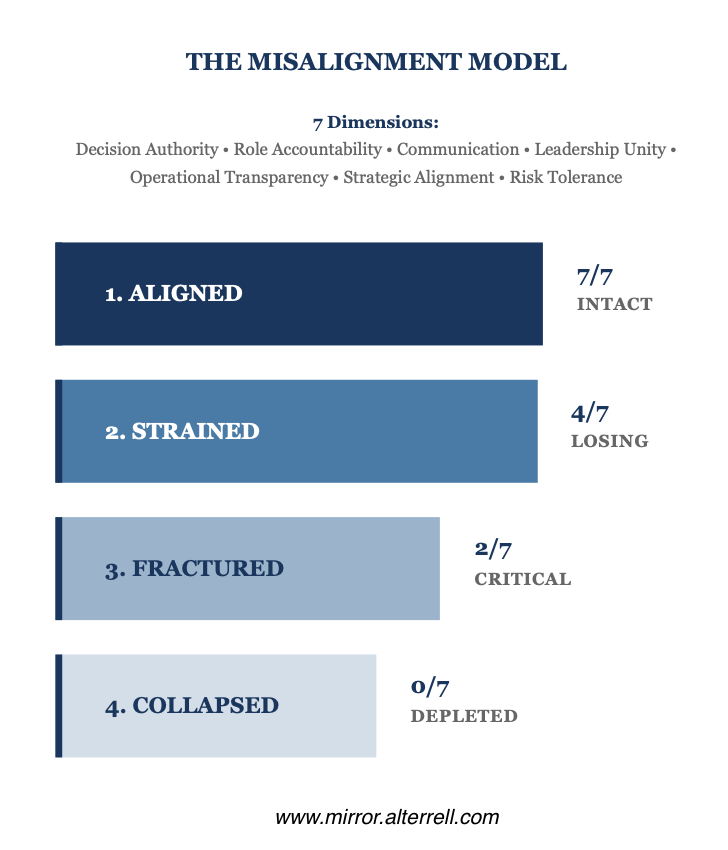
Over the span of founder interviews and post‑mortems, we found the same seven dimensions show up again and again. If unsurfaced tension exists, it almost always traces back to one (or more) of these.
This is not personality theory: it is structural (see misalignment model below). You don’t fix founder conflict by improving communication alone. You fix it by clarifying the system you are operating inside.
Most teams won’t leverage therapy and fear involving an intervening party. What they need — and where The Mills Mirror™ comes in is by providing — explicit agreements in the places co-founders assumed were already understood.
The 7 dimensions matter because they surface structural misalignment before collapse. Clarity early is cheaper than repair later.
Decision Authority
When everything is calm, consensus feels amazing. Under pressure, slowed decision authority becomes a bottleneck.
Who has final say when you disagree — not in theory, but in practice?
If that answer changes depending on the situation, you don’t have shared authority. You have ambiguity. Ambiguity slows execution and can breed resentment when ownership is too diffuse.
Ownership & Accountability
Equity splits are clean on paper but messy in real life.
Who owns outcomes when things go right — and when they don’t? Where does responsibility end and “helping out” begin?
Partnerships strain when one person becomes the default backstop for everything the other co-founder avoids. Over time, this turns into invisible labor that no longer matches the initial equity split.
Risk Tolerance
Founders often agree on vision but differ on how much uncertainty they can stomach to get there.
What is the venture’s actual appetite for risk — and whose comfort level sets it?
One co-founder pushes for aggressive bets. The other optimizes for survival. Neither is wrong — but misalignment creates a constant feeling that the company is either reckless or stagnant. Risk tolerance is not a mindset issue or purely strategic: its physiological.
Communication & Conflict Style
Some founders process externally. Others need time to think. Some address tension immediately; others avoid conflict until they feel certain.
What is the default communication and disagreement style?
When styles clash, conversations become circular or delayed — not because the issue is unsolvable, but because the timing is mismatched. Unresolved friction doesn’t disappear: it stockpiles.
Power Structure (Leadership Unity)
Early on, leadership can feel interchangeable. As pressure increases, hierarchy emerges — intentionally or not.
When push comes to shove, who leads and who defers?
If this is unclear, co-founders can unintentionally undermine each other, internally or externally. Teams sense this immediately, even when no one names it. Perceived unity often masks unresolved power questions.
Information Flow & Visibility (Operational Transparency)
Startups move fast, and information often travels unevenly.
Who knows what, and when do they know it?
When visibility is inconsistent, surprises become common and trust erodes quietly. One founder may feel excluded while the other feels burdened by having to relay everything. Misalignment often begins as information asymmetry, not disagreement.
Strategic Alignment
Shared excitement can obscure differences in long-term expectations.
What does success actually look like — for the company and for each of you? Do you want the same scale, timeline, level of control, and exit outcome?
Misalignment of strategic alignment creates directional drift that shows up as repeated debates about priorities, pacing, and tradeoffs. You cannot align strategy if you are solving different relational problems.